Archive for September, 2007

Thursday, September 27th, 2007

National Book Festival

Anyone in or around DC this weekend should head to the National Mall for the National Book Festival.* The festival will be held, rain or shine, on the National Mall between 7th and 14th Streets from 10 am to 5 pm on Saturday, September 29.

Seventy authors will be on the Washington Mall, giving readings, signing books, meeting with festival goers. We’ve highlighted each of these authors here on LibraryThing, with a special NBF button (see, for example, Jodi Picoult). You can see the entire list of authors here, on The National Book Festival’s authors page.

They just added interviews with some of the authors; podcasts can be found under National Book Festival Podcasts. I’ve also gone through and added links to each of these on the respective author pages. Enjoy!

LT Group
There’s even a group on LibraryThing dedicated to the event (National Book Festival group). Join in to talk about the authors, RSVP for the meet-up, and more.

Meet-up
LT members have organized a meet-up (thanks SqueakyChu!): The National Museum of Natural History, base of the front stairs, far right hand side when facing the building. 2pm. Be there or be square. (Details in this talk post).

*The festival is sponsored by the Library of Congress and hosted by Laura Bush.

Labels: authors, National Book Festival, NBF

Tuesday, September 25th, 2007

LibraryThing for Libraries: Richland County, Cal State – Channel Islands and San Francisco State University

Richland County Public Library

San Francisco State University (source)

Cal State University – Channel Islands (source)

LibraryThing for Libraries just passed another milestone: we now have too many customers to keep track of in short-term memory.

Our first new library is the Richland County Public Library. We’re really excited to have them on board, since they’re the biggest public library we’ve worked with so far—at nearly three million checkouts a year. They’re doing a lot of simple yet innovative things, like offering reference via instant messaging and having a kid-friendly website. Of course, they have a blog too. I have a soft spot for large public libraries, having worked in one for several years and having lived in big cities with great library systems (Denver, Salt Lake City and Seattle) for most of my life. We hope to be adding many more large public libraries in the coming months.

Our second library is the San Francisco State University library. With around 30,000 students and four million items owned by their library, they’re a big one too. They’ve got one of the best- looking and easy-to-use library websites I’ve seen (and I look at a lot of them – occupational hazard). Their electronic resources librarian did an excellent presentation on LibraryThing for Libraries a few weeks back.

Our third library is Cal State University – Channel Islands, located in the beautiful area between Los Angeles and Santa Barbara. They’re our first Voyager customer, and we’d like to thank them for helping us work out how to make Voyager work with our widgets. They’ve also volunteered to be our latest data source for book searching.


Photo credits: (1) Courtesy Richland County Public Library. (2) CSUCI bell tower by Flickr:AIBakker (CC Attribution-NonCommercial-NoDerivs 2.0). (3) Library by Flickr:relic (CC Attribution-NonCommercial-NoDerivs 2.0)

Labels: csuci, librarything for libraries, rcpl, richland county, sfsu

Monday, September 24th, 2007

Early Reviewers now free to publishers

The short version: We’ve made LibraryThing Early Reviewers—our program to hook publishers up with LibraryThing members willing to review upcoming books—entirely free for publishers. The response has been huge. We’ll have seven publishers and twenty-four titles this October!

The long version: We planned on charging publishers to participate in the program. Publishers were eager to do it even so. Certainly its closest analogue, the Amazon Vine program is charging. (Our sources say “an arm and a leg.”). Also, it takes work on our side.

Then we decided: What the heck? Pricing discussions took time and limited the reach somewhat. And we figured out how to automate the process better. When in doubt, we err on the side of openness. More publishers means more books, more books means more happy members, more reviews, and more fun.

We’re looking forward to announcing the October batch. So far, we have 7 publishers signed up, with a total of 24 different titles and 420 copies in total. It’s a mix of fiction, and non-fiction, with reference and even poetry books on offer. That’s a lot of books, and we think it can get even better.

I like to think of Early Reviewers as playing matchmaker between publishers and readers. The idea is a simple one—give free pre-publication books to people in exchange for reviews. But it’s surprisingly hard to find the *right* people to review the books. That’s where LibraryThing and the whole matchmaker scheme comes in. We match members to the books based on the other books in the library, so the books end up in the right hands.

For members: I’ve added a section to WikiThing with an FAQ on Early Reviewers for members—what it is, how to sign up for a book, where to post your review, and more.

For publishers: Introduction to LibraryThing Early Reviewers for publishers

We’re going to do monthly batches of Early Reviewers, so I’m always working on gathering more publishers and books. If you know of any interested publishing houses, send them my way!

Labels: early reviewers, publishers

Sunday, September 23rd, 2007

Tagging innovations, from the government

Has anyone seen click-based tag clouds? These are tag clouds in which the size of the words depend not on the number of times something has been tagged, but on the number of times the tag is clicked.

I never had, but Abby just spotted on the website of the the State of Delaware. Apparently site visitors are interested in employment.

It’s a pretty cool idea, and one I’d love to try out on LibraryThing. It wouldn’t work on work pages, but it might on the home page. And I’m impressed that it was on state-government site. While these sites are increasingly competent, they’re not usually thought of as a hotbeds of web innovation.

Labels: tagging

Saturday, September 22nd, 2007

Magical Thinking at Harvard

A Babylonian Demon Bowl (Kelsey Museum)

“Know the secret name of something and you control it,” is an extremely ancient idea, stretching as far back as the Sumerians, and running through subsequent Mesopotamian, Egyptian and Greco-Roman magic. The secrecy of the name was critical to its power, and to the mystique of those who knew it. One suspects it also helped their hourly rates.

It’s modern equivalent is the “unique identifier.” Information is available as never before, but its sheer quantity limits discovery. Unique identifiers cut through the clutter. And they can be powerful. Let the wrong person know your Social Security Number and you’ll be in a world of hurt as great as a malevolent spirit caught by a name under a Babylonian demon bowl.

In the legal world the equivalent is the West American Digest System, which numbers court cases for lawyers. Although the cases are invariably in the public domain, the numbers that identify them are not. And controlling “the only recognized legal taxonomy” gives its creator, West Publishing, a valuable monopoly.

In the book world, it’s the ISBN. Know a book’s title and you can find yourself away in a sea of editions. Discover its ISBN and you’ve got it for sure. Type the ISBN into BookFinder or Abebooks.com and you’ve a panoply of new and used sellers.

Although assigned by private firms, ISBNs will never go the way of the West American Digest System. But their power explains why the Harvard Coop* has taken to ejecting customers who attempt to write down ISBNs. As reported in the Crimson, this is exactly what happened to one Harvard student, Jarret A. Zafra. In another (?) incident, reported by the Herald, the Coop called the police on three more ISBNs-scribblers.** When asked about the policy, Coop administration told the Crimson that it “considers that information the Coop’s intellectual property.”

The IP claim is hogwash. ISBNs are facts. Under US law facts can’t be copyrighted. The Coop is probably within its rights to expel whomever it wants, bhat won’t stop people from trying. The three students above were volunteers for a site called CrimsonReading.org, which is compiling a complete list of all books used at Harvard. When a Harvard Student types in an ISBN, CrimsonReading connects them to new and used booksellers. Affiliate revenues go to charity. By calling on volunteers and getting Harvard professors involved, CrimsonReading is getting around the Coop’s magical secrecy. Three cheers to them for doing it.

We need more projects like CrimsonReading. Much the same idea was behind my Google Book Search Search bookmarklet, which asked volunteers to collect Google Book Search IDs. In this case, the unique identifier was new and more secret. By giving its scans unique—and effectively secret—numbers, Google is creating a whole new bibliographic identification scheme. And where ISBNs cover only about thirty years of books, Google’s IDs are designed to cover every book printed, including millions in the public domain.

Control the name and you control the thing. It’s what WestLaw is doing. It’s what’s what the Coop is trying to do.

Is it what Google is doing? I’m not sure. And I don’t see any signs of this happening on its own yet. For example, sellers on used book sites are not using Google Book IDs to nail down editions. But the danger is there.

Secret and proprietary numbering systems pose a serious challenge to the benign potential of the internet. When the secrecy or obscurity are used against this potential, people need to act up—and break the spell.


*Always pronounced “coop,” not “coöp.” Full disclosure: My parents belong to the Coop, which is a true “cooperative” in organization. This means they share in the annual dividend accord to how much they spend there. So I’m working against them!
**I grew up near Harvard Square, and the Coop was one of my haunts. (It’s a general-purpose bookstore as well.) Quite a few of my friends were expelled from the Coop for shoplifting. If CrimsonReading really wants to get the job done, it should enroll the private-school street urchins of Square in the ISBN game.

Labels: google book search, harvard coop, isbns, open data, westlaw

Friday, September 21st, 2007

Early Reviewer books shipping; Second Life announcement

The September batch of Early Reviewer books is now closed, and books are about to start arriving on the doorsteps of 75 lucky winners.

Once again, we were oversubscribed this batch—1,550 people requested those 75 copies, giving us a good test for the algorithm matching books to people! Thanks to Unbridled Books and Nimble Books for the books, and we’re all looking forward to reading those reviews! To everyone who didn’t get a book this time around, don’t give up hope! We have a LOT of books coming in the October batch.

We also have a big announcement about LTER coming early next week, so stay tuned…

Second Life. A quick note about Second Life—LibraryThing members gather there every Saturday at noon (Second Life Time). This week there’s an animal themed Bookstacks quiz. Want more info? Check out LibraryThing’s Second Life group.

Labels: early reviewers, second life

Thursday, September 20th, 2007

Better default cover images?

There are a few small, but cool things about Google Book Search. I’m fond of book covers they show when a book doesn’t have a cover.

It’s quite a simple trick—a series of default images with HTML text over them. Here’s my shot at the same technique, using an image I found online, doctored somewhat.* (I’ve put it on the new work page I’m developing, a much simpler one.)

I think it would be cool to have a bunch of these, including ones with more personality, and to allow people to choose among them if they want.

Personally, I’d love to make one for my Loeb Classical Library books. Those are the read/green Latin/Greek books you’ve seen racked up at well-stocked Borders. I’ve got dozens of them. Most of mine are old and don’t have ISBNs. They show up as identical beige rectangles now. In the real world, they all look the same too, but they’re much more distinctive. (Martha Stewart Living** has a great photo of a set she bought for her daughter’s East Hampton cottage.)

This isn’t a priority obviously.*** But I think it would be fun to do at some point, I think—and to get others involved with. If anyone wants to help out, let me know. Either way, maybe we can do a contest for it later.


*Copyright doesn’t protect a faithful photograph of a cover such as this. Copyright requires an element of originality. Scans–such as the scans used by Google books and others–can’t be separately copyrighted either. The underlying book can be, if it hasn’t expired, but a perfectly faithful scan cannot. Sites like Google get around this problem by writing restrictions into the terms of use.
**Not a common read for me… I love the web. I found a reference here. Apparently decorating with Loebs is a fairly common thing. According to this link, Martin Scorsese has a decorative set as well. According to this link, Oprah has one too. She should do a Book Club on Silius Italicus.
***And no criticism about blogging this instead of doing [fill in bug or feature here], please. I’m pushing 14 hours today! 🙂

Labels: features

Thursday, September 20th, 2007

Link LibraryThing accounts to Google?

Check out the main LibraryThing blog for a discussion of whether LT should encourage users to link their accounts to Google Book Search.

Labels: metasexdactyly

Thursday, September 20th, 2007

Link LibraryThing accounts to Google?

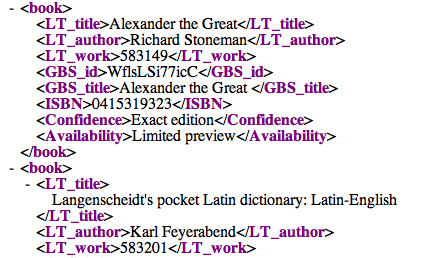
As I said in my talk post, we have spoken to Google about how to link and search Google Book Search reliably and effectively from LibraryThing.
Unfortunately, I am not at liberty to discuss much more than that. I can say that there is no substance to the rumor that Google is re-engineering CueCats to beam targeted advertisements onto your bedroom wall. I am also able to concede that the press accurately reported how Larry and Sergey beat me at drunken thumb-wrestling. But I cannot comment on whether Abby, sober and wielding a hitherto-unnoticed sixth finger, restored LibraryThing’s honor.

Here’s a hypothetical proposal. We could basically do this now, without Google’s help. And maybe Google could help.

Imagine if LibraryThing members could search across their books using Google BookSearch. That would be great, right?

But to do it, members would have to link their books to their Google account, connecting what they’ve cataloged on LibraryThing to the account that unites GMail, Blogger, Google Reader, Google Talk, Orkut, and the rest. And, by doing this, they would also connect their reading to their Google search history.

If this were to happen, connecting your LibraryThing and Google accounts would be voluntary, but searching your library all together would require that link, and require Google having all of your books from LibraryThing. I’m not sure what, if anything, Google would do with this information—perhaps nothing—but the option would be there.

What do people feel about this? Would you do it. Would allowing some absolutely private books to stay on LT help? What would make this work or not work?

Labels: drunken thumb wrestling, google book search, privacy, sexdactyly

Wednesday, September 19th, 2007

Talk Like a Pirate Day. arrgh

Arrr, make me walk the plank, because I only just remembard that today’s a ‘ery important day. Aye, Talk Like a Pirate Day, o’ course. Ye’ll ne’er get me buried booty! (Luckily, I found a useful pirate-speak translator).

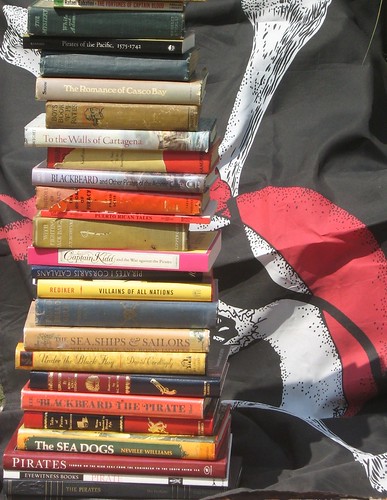
So let the fun begin with a couple of contests (as if the sheer glory of Talk Like a Pirate Day weren’t enough). This photo by Topper was last year’s winner of the Talk Like a Pirate Day bookpile contest, and we’re looking for this year’s! So, the first contest is a good old fashioned LibraryThing book pile contest.

Book pile contest: the rules

  1. Pile up your books. Be creative.
  2. Take a photo.
  3. Post the photo. You can do either of the following:
  4. Wait for us to crown a winner

the deadline: Wednesday, September 27th at noon EST (just over a week, so get cracking)

The second contest is a a haiku contest. One of the greatest things to come out of the launch of WikiThing (in my humble opinion) was the creation of help in the form of haiku. Started by tardis (a genius), LibraryThing Haikus now holds a place of honor on WikiThing, and has expanded to include not only Help, but also general LT haikus, and Library 2.0 haikus.

Haiku help contest: the rules

  1. Write a haiku. Or seven.
  2. Post them to the LibraryThing Haikus page on WikiThing.

the deadline: well, you can keep adding them forever, but we’ll pick a few winners at the end of the month.

Here’s a few for inspiration.

How to create
account? Put user name and password
in green box on home page
tardis

Can we have wishlists?
Yes, they are coming to us
with the winter winds…
readafew

All the books you’ve read,
an endless field of poppies;
Try UnSuggester!
Felius

Bonus points for combining haiku, LibraryThing help, and Talk Like a Pirate Day. Tim’s attempt (note he even respects the generic weather rule):

When autumn seas change
Scurvy dogs to lubbers, aye,
Get a blog widget.

PRIZES: Yes. There will be prizes, for both contests. Possibly in the form of buried treasure, possibly in the form of gift accounts.

Labels: book pile, contests, haiku, talk like a pirate day, wikithing

Tuesday, September 18th, 2007

Google Book Search Search…

I am voluntarily and temporarily suspending Google Book Search Search, our effort to distribute the task of collecting Google books IDs for LibraryThing members through a browser “bookmarket.”

I am talking with Google about some other approaches that they might be able to simplify the process of linking to Book Search pages. Google has communicated their desire to make it easy for sites like LibraryThing and libraries to link to Google books appropriately and successfully.

The GBSS bookmarklet showed the power of the LibraryThing community. In about a day more than 1,500 LibraryThing members (and many non-members) installed the bookmarklet and collected GBS link data for over 253,000 of theirs and others books. If we had solved more of the browser issues, I’m sure we would have collected many more.

The links members discovered will be kept, and the data is available. We will be adding new tools for members to edit and add Google book ID information by hand, if necessary.

As you may guess, we are going to be doing some listening, some talking and some thinking. I would be grateful for your continued support as we work through this.

Labels: features, google book search

Monday, September 17th, 2007

Evilness — Opposition — Policy and Procedure

Someone recently called LibraryThing for Libraries out over our terms and privacy policy. Guess what? They were right to do it!

The policy was vague. It didn’t describe what we actually use library data for and how we use it. It gave us potential room to do bad things.

Well, we don’t want the room. We’ve always treated our user and library data carefully, and we always will. So we’ve written it again, this time as a straight-jacket.

You can read the full text here, but the Cliff’s Notes version is this:

  • We don’t collect any data from or about library patrons;
  • We only use a library’s data to enrich their own catalog
  • We’re not allowed to change the policy suddenly

If anyone feels we’ve left anything out, let us know.

Labels: librarything for libraries