Archive for January, 2009

Saturday, January 31st, 2009

Cataloging and fun

On Thursday we introduced a silly new “meme” page called “Dead or Alive?” which listed your authors by their mortal status–alive, dead, unknown or “not a person.” (See the blog post or check out yours.) The feature drew on the birth and death dates of the authors in our Common Knowledge system, a free (Creative Commons) “fielded wiki” for miscellaneous “cataloging” information (think “Wikipedia for book info”). To move an author from the “unknown” column, members had to find their dates and enter them onto into Common Knowledge.

Here’s a chart of Common Knowledge contributions over the last month.* Can you spot the day “Dead or Alive?” went live?

As you can see, birth, death and gender edits (gender is where you mark an author as “not a person”) went through the roof when the feature was announced—from an average of 143 edits per day, to 3731 and 3584, 25 times the average. Other edits went up too—a 30% increase.

A few members joked that it was a plot to encourage contributions to Common Knowledge. It wasn’t that. I just thought it was a funny idea, but I wasn’t unaware that it would have that effect. Indeed, the upshot shows again something of a LibraryThing finding—that regular people will contribute cataloging information if you make it meaningful to them. That is, whatever incentive there is to add author information, the incentive is increased when they’re your authors, and increased again when that information does something for you. Of course, even if incentive is personal, the effect is general; you update the author because you have his or her book, but everyone else shares in the value of that update.

The way this works undercuts a common myth of “Web 2.0″—that there are all these people out there adding “user-generated content” out of altruism or an extreme mismatch between time and exciting things to do. And it cuts against an older myth, that cataloging is so boring you have to pay people to do it.

We’ve seen the same jump every time we introduced a new Common Knowledge category, and again when we made that category “come alive” in some way for members. And although the short-term jump will surely level out, the overall rate of “dead-or-alive” entries certainly not. You get more changes when the changes do something for people.

Now, of course, there’s a whole list of things this doesn’t mean. It doesn’t mean that LibraryThing members are doing their job well (although I suspect they are). It doesn’t mean the same would apply to much more difficult forms of cataloging, or to forms that generally presuppose professional training (ie., LCSH). And it doesn’t mean that regular people will get to the “rare stuff,” indeed it probably means that average cataloging attention is directly related to popularity of the underlying item.

Even so, pretty cool. Oh, by the way, I’m adding a feature allowing you to compare yourself to other members, which should inflame the other great motive for personal metadata—competition. After all, my library has a higher dead/alive ratio than yours!

UPDATE: Here’s the current chart, without day-norming. Notice how everything went up.


*The numbers are normed against day-related changes. Basically, we smoothed out that many more edits are made on Monday than Saturday.

Labels: cataloging, dead or alive, social cataloging, zombies

Thursday, January 29th, 2009

Twitter your books to LibraryThing

We’ve added integration with Twitter, the popular SMS/microblogging site. Basically, it’s an easy way to add a book to your LibraryThing while standing in a bookstore, library or friend’s house.

Go to the new Edit your profile: Sites page to add your username. Once you follow LThing, you can direct message at any time to add a book to your library.

Example:
D LThing [ISBN or Title] #tag1, #tag2, etc.

Add my wife’s novel, Every Visible Thing with the tag “wishlist”:
D LThing 0066212898 #wishlist

Add Huckleberry Finn:
D LThing Huckleberry Finn

Search always goes off Amazon for now. It picks the first edition if you don’t specify.

Coming soon: We’ll be integrating deeper soon, so you can let your Twitter friends know when you add or review books on LibraryThing.

Follow us: The LThing account will only be used to send out Twitter/LibraryThing messages. If you want to follow what I’m doing my Twitter account is LibraryThingTim.

Labels: new feature, new features, twitter

Thursday, January 29th, 2009

Did we mention we sell barcode scanners?

Why did we order so many? Buy a CueCat barcode scanner for $15 or the LibraryThing office’s floor will give way and rain dot-com destruction on my family’s home.

CueCat scanners work on LibraryThing without any modification. Got one already? Read the handy—user created!—guide to using CueCats with LibraryThing.

Labels: barcode scanners, barcode scanning, cuecat, cuecats

Thursday, January 29th, 2009

Brains! Brains!

New Feature. I just released a minor feature, a new meme “Dead or Alive?” which breaks down your LibraryThing authors by whether they’re dead, alive or unknown. Check out mine or go to your profile and select “Memes” to find yours.

The information is based on the various authors’ birth and death dates in Common Knowledge. It works pretty much as you suspect. People with death dates are dead. People with birth dates only are alive, unless they’d be over 100. The rest are unknown. The system tracks when you use it, so I can add some statistics on whether your authors are more or less dead than others’ authors.

UPDATE: For clarity, you can change authors by going to their author page and editing in a birth or death date. For now, organizations are identified by being of the gender “n/a.”

New Books. I need no segue to mention two books I recently discovered. The first is Pride and Prejudice and Zombies from Chronicle Books, due out in April. According to the description:

“Pride and Prejudice and Zombies — Pride and Prejudice and Zombies features the original text of Jane Austen’s beloved novel with all-new scenes of bone-crunching zombie action. As our story opens, a mysterious plague has fallen upon the quiet English village of Meryton—and the dead are returning to life! Feisty heroine Elizabeth Bennet is determined to wipe out the zombie menace, but she’s soon distracted by the arrival of the haughty and arrogant Mr. Darcy. What ensues is a delightful comedy of manners with plenty of civilized sparring between the two young lovers—and even more violent sparring on the blood-soaked battlefield as Elizabeth wages war against hordes of flesh-eating undead. Complete with 20 illustrations in the style of C. E. Brock (the original illustrator of Pride and Prejudice), this insanely funny expanded edition will introduce Jane Austen’s classic novel to new legions of fans.”

It’s an amusing idea. Taking on classics from a different vantage point has been done many times—think Wide Sargasso Sea, whose heroine is the “madwoman in the attic” of Jane Eyre. Others have have done prequels and sequels to famous works; at a low-point of my youth I read the entirety of Heathcliff—The return to Wuthering Heights. But has anyone taken the full text of a classic and inserted scenes of an entirely different character? The possibilities are endless. It’s the tragic story of star-crossed lovers set against the backdrop of 16th-century Verona—and an alien invasion! (Working title: Romeo and Juliet and Aliens).*

Another good titles is Jailbait Zombie by Mario Acevedo, picked up by Sonya at the recent American Library Association meeting in Denver. According to Sonya’s friend, another zombie-lover (but not literally), Zombie Jailbait “isn’t as good as the author’s Undead Kama Sutra,” an assessment that brings into high relief the problem with comparatives.


* I’m looking for other good titles. There is, of course, the moving story of two parents locked in a tragic custody battle over their young son—and stalked by a killer from another planet (Kramer versus Kramer versus Predator), but the movie is better known than the book.

UPDATE: A commentor points out All the World’s a Grave by John Reed, piecing together Shakespearian lines into a new play. The granddaddy is Pingres of Halicarnassus’ lost reworking of the Iliad, inserting a pentameter of his own creation between Homer’s hexameters (here). Those aren’t quite what I’m talking about.

Hat-tip to Lux Mentis for Pride and Prejudice and Zombies.

Labels: humor, new feature, new features, zombies

Monday, January 26th, 2009

January Early Reviewer bonus batch

We just posted a bonus batch of Early Reviewer books for Janurary! Spiegel & Grau are offering 100 copies each of two new books.

First, make sure to sign up for Early Reviewers. If you’ve already signed up, please check your mailing address and make sure it’s correct.

Then request away! The list of available books is here:
http://www.librarything.com/er/list

The deadline to request a copy is Wednesday, February 4th at 6PM EST.

Eligiblity: Publishers do things country-by-country. The books in this batch can be sent to the US only.


Labels: early reviewers, LTER

Thursday, January 22nd, 2009

Bowker/CIG news..

Over on the main blog, I wrote a long post about LibraryThing CIG/Bowker deal. It’s an excellent deal.

Read the details here.

Labels: bowker, CIG, librarything for libraries

Thursday, January 22nd, 2009

The Guardian asks “Why you can’t find a library book in your search engine?”

The OCLC data-grab has hit the “real” media—an article in the Guardian. The article asks the simple question, “Why you can’t find a library book in your search engine?”

It’s an obvious question. The answer isn’t quite as simple as they put it. Libraries would be in Google if their library catalogs could be spidered. But they’d still be hampered by OCLC in various ways. Anyway the coverage of OCLC, Open Library, LCSH.info and LibraryThing are spot-on. And the subtle nationalist angle—an American site!—can’t hurt.*

Three cheers for the Guardian. Next up, the New York Times? We can hope.

*Did you know OCLC invaded Iraq?

Labels: guardian, oclc

Wednesday, January 21st, 2009

LibraryThing and CIG—the deal!

LibraryThing has just partnered up with Cambridge Information Group, which owns Bowker, AquaBrowser, ProQuest, Serials Solutions and RefWorks.

The deal went down as follows:

  • CIG bought a minority stake in LibraryThing. I still own a majority of the company myself.
  • CIG, through Bowker, is now the exclusive distributor of LibraryThing for Libraries, our cool catalog-enhancement project. LTFL puts tags, recommendations and reviews directly into your library catalog (see the Seattle Public Library for an example).

It is an excellent deal. We got a new minority owner, with a lot of experience in the book world (but with different strengths than our other minority partner, AbeBooks), much-needed growth money and a great opportunity to reach more libraries.

There is no downside whatsoever. Nothing else has changed. Member data stays with us, under the same rules. All our free, public or Creative-Commons data, including covers, stays as it was. Management and majority ownership stay with me. We stay small, quirky and in Maine.

Selling LibraryThing for Libraries. We are overjoyed that Bowker is taking over sales and marketing of LibraryThing for Libraries. LibraryThing for Libraries has been a success, with almost 150 libraries so far.* But we aren’t salespeople—the libraries mostly came to us. Sonya has done a great job as stand-in-salesperson, but neither she or anyone else at LibraryThing has sales experience, let alone to libraries. We’re programmers and librarians!

Partnering with Bowker and its extraordinary sales team gives us the chance to reach out to many more libraries—and lets the LibraryThing team do what we do best—make things.

Don’t worry. LibraryThing for Libraries pricing isn’t changing. We’re still in charge of tech support. And we’ll still be going to the big library conferences and usually have our own booth—jumping over to Bowker’s for presentations and such. The rhino stays. We just have more people to rhinotoss with.**

Moola. LibraryThing has been profitable for a while, but we didn’t have much of a cushion. It was a nail-biter. We needed servers and new employees, but what if we had a few down months? And did I mention the economy is sick? (Cut to Tim worrying.)

The CIG deal frees us from worry and gives us room to grow. While the rest of the economy downsizes, we’re going to build and hire. We had already bought two new servers and brought on an employee and a temp to replace Abby for a while. More is coming. Did I mention we’re hiring? Oh, we’re also looking for library programmers, wherever.**

Partners. For us the big sell was the Bowker sales team and the opportunity to work with some talented technical people. We look forward to working with Bowker, ProQuest and Serials Solutions. (We did get a sneak-peak at Serials Solution’s new “Summon” product, a sort of Google for your library—and think it’s excellent.) But we’re particularly happy to talk to the people at AquaBrowser, a wonderfully innovative Dutch company acquired by CIG last year. We’ve had a crush on AquaBrowser for some time now. Theirs was the first library catalog software (OPAC) to integrate LibraryThing for Libraries content directly into their software—a deal cemented in ten minutes over sushi and beer. We are going to try hard to think up projects that require face-to-face meetings in Amsterdam.

As a side deal, some LibraryThing data will be appearing in Bowker’s flagship Books in Print service. This was, however, planned before the larger agreement, and is a data sale like any other—only anonymous or aggregate information is provided. You can change who gets your reviews on your account page—anyone, just libraries or nobody at all.

Our shot. I have a simple internal label for this deal: We are going to get our shot. LibraryThing has done very well considering its humble origins and structure. If we had gone the venture capital route we’d have started with a lot more money, but we’d have to “flip it” about now–just when things were getting exciting. Instead, this deal means we get to keep our souls, and get our full shot at making LibraryThing.com and LibraryThing for Libraries everything we want them to be. That’s a wonderful opportunity.

For members, this is also great news. You’ve waited a long time for some features, and scaling has been a problem. Everything can’t happen right away, but it can happen. With your help and criticism we can continue to build the site you want, and support the community you created.***


*Eighty-five are done by us. The rest get LibraryThing for Libraries data though Aquabrowser MyDiscoveries.
**It wouldn’t be LibraryThing if I didn’t come as clean as I can. I made some money on the deal. I can’t say how much, but it wasn’t very much. It was essential to me that most of the money go to the company, because I’d rather have opportunities to do cool things than money and limits. (Kudos to my wife for seeing it this way too!) As you might imagine, I’ve had offers to sell out, and I’ve refused them. I am having the time of my frickin’ life. My work life was never like that before, and it bleeds over into everything. It is a joy, a pleasure and an honor to be building the scaffolding of site inhabited by so many interesting people doing so many interesting things.
***The averages won’t change, but Bowker may ditch our weird self-created metrics (eg., “circulation, but for books only, not counting ILL or renewals” a number absolutely nobody knows).

My thanks to the team at CIG for their patience, particularly CIG President Andy Synder, who wouldn’t take no for an answer and guided this deal through many shoals. It’s a confident, strategic company that looks ahead like this in a period of financial uncertainty. Thanks as well to Boris, Hannes and Russ at Abebooks and Amazon for sticking with this, to Angela and the team at Bowker who are so clearly going to make this work, and to Jasper and Taco over at AquaBrowser for promising to fly me to Holland—and hey, Curaçao is Dutch, right?—for bi-monthly very important work meetings.

Labels: bowker, CIG, deals, librarything for libraries

Tuesday, January 20th, 2009

Inauguration at the LibraryThing offices


Labels: Uncategorized

Tuesday, January 20th, 2009

Open Shelves Classification

The first draft of the top level of the Open Shelves Classification is ready.

If this means nothing to you, check out this post I wrote for our ideas blog, Thingology.

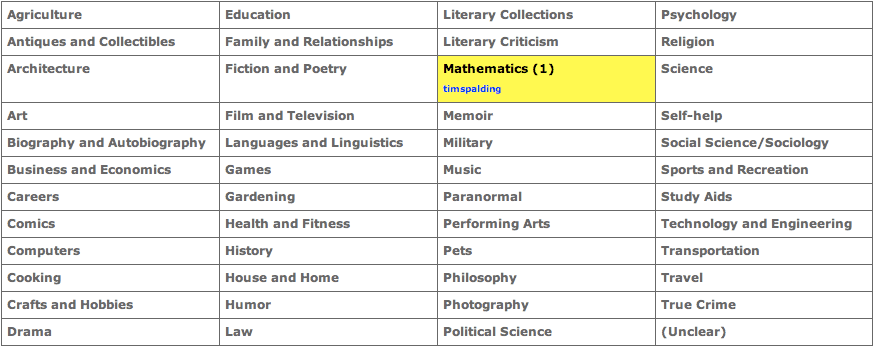
Want to help? Go to a work page in LibraryThing and scroll down to the bottom. You’ll find a chart of the top-level categories. If you see a good match, click on it. You’ll be prompted to say whether you know the book yourself or not. And then you’ll get to see how your classification vote match up with anyone else on the site.

You can classify anything in LibraryThing. If you want to help the most, however, click the “Find a random work” link here or below the classification chart. It’ll take you to a random work, but also contrive to get multiple members classifying the same works. The idea is that it’ll give us a good idea what categories are easy and obvious, and which are causing doubt.

Whatever you find, come and talk about it on the Open Shelves Classification group.

Labels: open shelves classification, osc

Tuesday, January 20th, 2009

Open Shelves Classification: First draft live and at ALA Midwinter

If you’re at ALA Midwinter in Denver on Saturday, come talk about this interesting new project. See below for details.

Back in July I blogged to start something called the Open Shelves Classification, a free, crowdsourced alternative to the Dewey Decimal System, and created a Group for it. Soon afterward two librarians, Laena M. McCarthy of the Pratt Institute and David Conners of Haverford took over leadership of the project. For the past six months they and a growing contingent of LibraryThing members, some librarians, some not, have been working to come up with basic principles and working on pieces and on the numbering system. They’ve also done some interesting work testing the proposed top level against real library records. Much of their work is collected on the Open Shelves Classification Wiki. Laena did a nice post on the OSC on the Public Libary Association blog.

The OSC team has reached some agreement on a first drag of the “top level categories,” some fifty categories that, it is hoped, all books fit into somewhere. And you are invited to help classify works in LibraryThing!

Want to help? Go to a work page in LibraryThing and scroll down to the bottom. You’ll find a chart of the top-level categories. If you see a good match, click on it. You’ll be prompted to say whether you know the book yourself or not. And then you’ll get to see how your classification vote match up with anyone else on the site.

You can classify anything in LibraryThing. If you want to help the most, however, click the “Find a random work” link here or below the classification chart. It’ll take you to a random work, but also contrive to get multiple members classifying the same works. The idea is that it’ll give us a good idea what categories are easy and obvious, and which are causing doubt.

Whatever you find, come and talk about it on the Open Shelves Classification group.

In Denver on Saturday? Laena and David are going to be at the ALA Midwinter show in Denver this weekend. (So are Sonya, Casey and I.) To move the OSC along we reserved a conference room at the Courtyard Marriott (Google Maps) from 1-3pm on Saturday, January 24th. Anyone at ALA is invited to come, as indeed are regular LibraryThing members–the Courtyard is outside the velvet rope.

Labels: ALA, ALA midwinter, alamw2009, open shelves classification, osc

Friday, January 16th, 2009

Library social media wins one

Update: We can’t make it to today’s Nylink/NYPL event. Get your tshirts at ALA Midwinter or by asking for one.

Big news. As you may have heard, OCLC has reversed itself and delayed its new Policy due to take effect in February. They will be setting up a “Review Board of Shared Data Creation and Stewardship”*, with broad member consultation promised. At best, they’ve heard the message and may end up embracing truly free and open library data. (A man can dream!) At worst their strategic retreat gives free-and-open data proponents time to articulate and broaden their case.

For people like me who have been pluging away at this for months and feeling increasingly depressed about what seemed the library world’s inevitable slide into data monopoly, it was a big, big win. The LibraryThing team went out to Silly’s. That’s a party.

Social media won. Content aside, however, it was a big win for library “social media,” particularly the “biblioblogosphere.”* OCLC’s new Policy was rushed through so quickly that it effectively bypassed traditional library-world tools, like professional conference. Press coverage too was minimal, late and mostly dependent on the blogosphere. Even the hastily-convened ARL/ASERL panel hadn’t spoken yet when OCLC felt the need to reverse course. The blogosphere was running ten- or twenty-to-one against the Policy.

Other social media also played their part. From the trendy, excitable Twitter to the cliquish Facebook to that forgotten workhorse of professional communication, the Listserv. Even AUTOCAT, which many of the Library 2.0 types I hang out with consider past hope, showed little support for the policy and much criticism. And over them all, the Code4Lib wiki was pressed into action tracking and aggregating what everyone was saying, allowing arguments to build on each other and makin it crystal clear to everyone that they were not alone.

Of course, we don’t know why OCLC changed course. There’s a rumor going around that important library director or two said they wouldn’t abide by it. It’s also possible that ARL/ASERL is going to come out solidly against it, and OCLC saw it coming. But even if the ultimate decision rested with some powerful people, they must have drawn on the blogosphere for information and support. Maybe the payoff from all those library-sponsored professional development courses won’t come from helping patrons get on the MySpace bus, but from getting the library world off a train to nowhere.

So, open-data people. You’re not alone. You have power. The library world is listening. What do you have to say?

Labels: facebook, oclc, social media, twitter