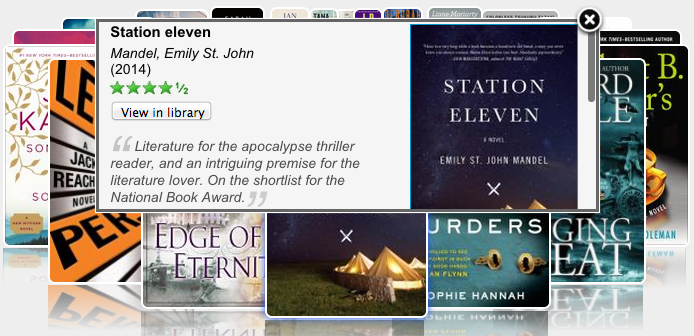
Our Book Display Widgets is getting adopted by more and more libraries, and we’re busy making it better and better. Last week we introduced Easy Share. This week we’re rolling out another improvement—Annotations!
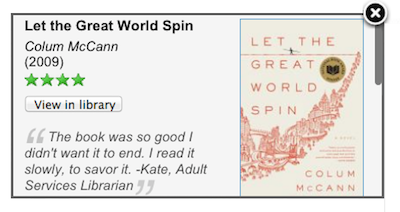
Book Display Widgets is the ultimate tool for libraries to create automatic or hand-picked virtual book displays for their home page, blog, Facebook or elsewhere. Annotations allows libraries to add explanations for their picks.
Some Ways to Use Annotations
1. Explain Staff Picks right on your homepage.
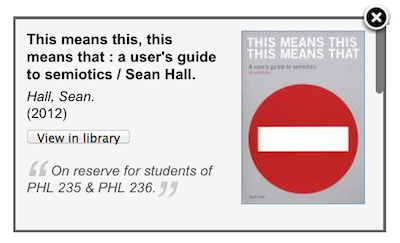
2. Let students know if a book is reserved for a particular class.
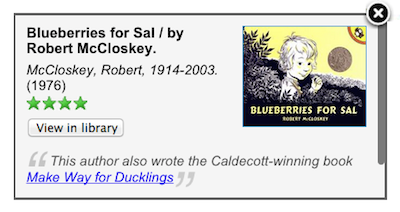
3. Add context for special collections displays.
How it Works
Check out the LibraryThing for Libraries Wiki for instructions on how to add Annotations to your Book Display Widgets. It’s pretty easy.
LibraryThing for Libraries is pleased to announce an update to our popular Book Display Widgets.
Introducing “Easy Share.” Easy Share is a tool for putting beautiful book displays on Facebook, Twitter, Pinterest, Tumblr, email newsletters and elsewhere. It works by turning our dynamic, moving widgets into shareable images, optimized for the service you’re going to use them on.
Why would I want an image of a widget?
Dynamic widgets require JavaScript. This works great on sites you control, like a library’s blog or home page. But many sites, including some of the most important ones, don’t allow JavaScript. Easy Share bridges that gap, allowing you to post your widgets wherever a photo or other image can go—everywhere from Facebook to your email newsletters.
How do I find Easy Share?
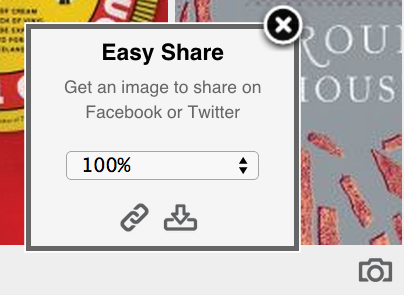
To use Easy Share, move your cursor over a Book Display Widget. A camera icon will appear in the lower right corner of the widget. Click on that to open up the Easy Share box.
How can I share my widgets?
You can share your widget in three ways:
Download. Download an image of your widget. After selecting a size, click the “down” arrow to download the image. Each image is labeled with the name of your widget, so you can find it easily on your computer. Upload this image to Facebook or wherever else you want it to go.
Link. Get a link (URL) to the image. Select the size you want, then click the link icon to get a link to copy into whatever social media site you want.
Dynamic. “Dynamic” images change over time, so you can place a “static” image somewhere and have it change as your collection changes. To get a dynamic image, go to the edit page for a widget. Use the link there to embed this image into your website or blog. Dynamic widgets update whenever your widget updates. Depending on users’ browser “caching” settings, changes may or may not happen immediately. But it will change over time.
You can also download or grab a link to a image of your widget from the widget edit page. Under the preview section, click “Take Screenshot.” You can see our blog post about that feature here.
Check out the LibraryThing for Libraries Wiki for more instructions.
Back in March we updated the widgets for sharing a bit of your LibraryThing library on your blog or other web page. We asked for your best widget design, and a bunch of you delivered the goods. I know its been over a month since the contest closed, and would like to assure you that this is at least 80% due to making cool new things for LibraryThing, and only 20% due to the creation of a company skateboarding gang. Such is Springtime.
First Prize. These five winners get a one year membership to the site. Transferable to a loved one if desired. Also their choice of a CueCat or t-shirt. The top 3 will go into the preset styles list on the make widget page.
paradoxosalpha‘s entry reminds me of a math classroom. I’m going to put it in the preset styles as “classroom.” Steal it.
Besides having a great comic collection, stephmo displays them with gusto. Many users do a cool things using the tags from their library to create themed widgets, with a background style to match. Look for it in the preset styles as “shazam.” Steal it.
gordon361 submits another one in green. The covers that float through here are often biographies, military, or history related, and they look very at home on this poker table green background. Its going in the presets as “Poker Table.” Steal it.
Everyone who submitted to the Contest threads will recieve a laptop/car sticker, a real-world widget.
If you’re one of the entrants, send a comment to user timspalding or email info@librarything.com to claim your prize. Include your member name, mailing address, and choice of prize, if applicable.
The new collections feature is making its way around the site. Two new features now, thanks to Mike:
Collections in widgets There’s a new option on the widget builder page that allows you to show books only from designated collection(s). Make a widget that shows off your “Currently reading” collection, or your “wishlist”!
Collections in import Want to import books directly into your wishlist? Or another collection? The Universal Import now makes that possible. After you upload your file, you can pick which collection to put all the books into.
The new widgets came with a bunch of pre-defined styles—of varying quality. But they also have sharing built in, so members can come up with better ones, and let people know about them.
First twenty-five members who post get a LibraryThing laptop/car sticker, a sort of real-world widget
Let’s see what you can do!
UPDATE: Luke added a feature to the “share with other LT member” that shows it with *their* books first. You can change it to work with yours instead. This only applies to URLs made now, so edit old ones?
We’ve just brought live new, improved widgets, available from the make widget page.
Some highlights:
New “animated” style cycles through your covers in a oddly mesmerizing way.
Widgets are extensively customizable, so you can fit them to your blog without any special knowledge.
Power users can do more, with Javascript and CSS customization. Check out Chris’ blog for stylish use.*
The new widgets are shareable (an example) so members can show off and swap styles. (Yes, we’ll be having a widget-creation contest soon.)
Widget links don’t go off somewhere, but open up a slick lightbox “mini-book” page, with your information and (optional) links, to LibraryThing and elsewhere. You can, of course, fill in your Amazon Associates code, if you want to make money off your widget.
Widgets now include (optionally) tags, ratings and reviews. You can filter by reviews and tags too.
The code is good—based on our improved JSON Books API and designed not to slow down your page (they’re “lazy-loading”). Weirdly this can make the widget look slow. That’s because it’s not slowing down the rest of the page!
Luke! Widgets were helmed by new employee Luke (member: LibraryThingLuke), who wrote most of the core code, all the styling options, the share system and so forth. Other LibraryThing people helped. Chris—hard at work on collections, we promise—chipped in some attractive styles. Mike wrote the crucial cover-animation code, something he’s been working on for our upcoming Facebook application. I made sure Luke got a list of changes every morning, including at least one thing I wanted the other way the day before.
Luke offered the following thumbnail bio:
“Luke Stevens lives in Portland, Me with his wife and three kids. He enjoys single malt scotch and silver-age comic books. He rides a motorcycle from the early 80’s that elicits laughter from his evil co-workers. Twitter: saintlukas; blog: sacremoo.com.”
Following on the release of LibraryThing for Libraries’ new Reviews Enhancement, I’ve created a widget for libraries to show off their most recent reviews.
These are the three libraries that are live so far.
Recent reviews from High Plains Library District
Recent reviews from Los Gatos Public Library
Recent reviews from Mount Laurel Library
Update: Our Mount Laurel is having some trouble with book titles. We’ll fix it soon.
It’s mostly designed to make it easy for people to link to LibraryThing only when we have the book. You can also dress up the link with copy- and review-counts, and an average rating.
I think regular members will be more excited by a JSON API to your own books. This will allow us and members to write new widgets—widget for reviews, for example—and better widgets. I’m want to write them so that all the JavaScript code that comes out it is automatically shared between members, both legally and technically.
The work-info API is a first step. Let’s talk about this and what should come.




 How can I share my widgets?


