Tuesday, October 14th, 2014

Send us a programmer, win $1,000 in books.

We just posted a new job post Job: Library Developer at LibraryThing (Telecommute).

To sweeten the deal, we are offering $1,000 worth of books to the person who finds them. That’s a lot of books.

Rules! You get a $1,000 gift certificate to the local, chain or online bookseller of your choice.

To qualify, you need to connect us to someone. Either you introduce them to us—and they follow up by applying themselves—or they mention your name in their email (“So-and-so told me about this”). You can recommend yourself, but if you found out about it from someone else, we hope you’ll do the right thing and make them the beneficiary.

Small print: Our decision is final, incontestable, irreversible and completely dictatorial. It only applies when an employee is hired full-time, not part-time, contract or for a trial period. If we don’t hire someone for the job, we don’t pay. The contact must happen in the next month. If we’ve already been in touch with the candidate, it doesn’t count. Void where prohibited. You pay taxes, and the insidious hidden tax of shelving. Employees and their families are eligible to win, provided they aren’t work contacts. Tim is not.

» Job: Library Developer at LibraryThing (Telecommute)

Labels: jobs

Tuesday, October 14th, 2014

Job: Library Developer at LibraryThing (Telecommute)

Code! Code! Code!

LibraryThing, the company behind LibraryThing.com and LibraryThing for Libraries, is looking to hire a top-notch developer/programmer.

We like to think we make “products that don’t suck,” as opposed to much of what’s developed for libraries. We’ve got new ideas and not enough developers to make them. That’s where you come in.

The Best Person

  • Work for us in Maine, or telecommute in your pajamas. We want the best person available.
  • If you’re junior, this is a “junior” position. If you’re senior, a “senior” one. Salary is based on your skills and experience.

Technical Skills

  • LibraryThing is mostly non-OO PHP. You need to be a solid PHP programmer or show us you can become one quickly.
  • You should be experienced in HTML, JavaScript, CSS and SQL.
  • We welcome experience with design and UX, Python, Solr, and mobile development.
shutterstock_59784454

The highly-photogenic LibraryThing staff only use stock photos ironically.

What We Value

  • Execution is paramount. You must be a sure-footed and rapid coder, capable of taking on jobs and finishing them with attention and expedition.
  • Creativity, diligence, optimism, and outspokenness are important.
  • Experience with library data and systems is favored.
  • LibraryThing is an informal, high-pressure and high-energy environment. This puts a premium on speed and reliability, communication and responsibility.
  • Working remotely gives you freedom, but also requires discipline and internal motivation.

Compensation

  • Gold-plated health insurance.
  • Cheese.

How To Apply

  • We have a simple quiz, developed back in 2011. If you can do it in under five minutes, you should apply for the job! If not, well, wasn’t that fun anyway?
  • To apply, send a resume. Skip the cover letter, and go through the blog post in your email, responding to the tangibles and intangibles bullet-by-bullet.
  • Also include your solution to the quiz, and how long it took you. Anything under five minutes is fine. If it takes you longer than five minutes, we won’t know. But the interview will involve lots of live coding.
  • Feel free to send questions to tim@librarything.com, or Skype chat Tim at LibraryThingTim.
  • Please put “Library developer” somewhere in your email subject line.

Labels: jobs

Wednesday, October 8th, 2014

Interview with Gregory Maguire

Some excerpts from our interview with author Gregory Maguire, which initially appeared in September’s State of the Thing.

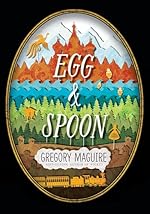
Prolific American author Gregory Maguire is best known for his adept reimaginings of classic children’s tales, like Snow White, Cinderella, and The Wonderful Wizard of Oz. His latest work, Egg & Spoon follows the adventures of a princess and a peasant girl—along with a host of interesting and absurd companions—in their home country of early 20th century Russia.

Maguire’s passion for children’s literature extends beyond writing, into teaching, as well as co-founding Children’s Literature New England, a nonprofit devoted to promoting awareness of the significance of literature in children’s lives.

Loranne caught up with Gregory this month to talk writing, reading, and witches, particularly Baba Yaga, who appears in Egg & Spoon (released earlier this month).

For readers who haven’t had a chance to read Egg & Spoon yet, can you give us the nutshell version of the story?

Egg & Spoon—imagining a high-concept spin such as they parody in skits about Hollywood—is The Prince and the Pauper, except with girls, meets Frozen, except everything is melting instead of freezing.

This book has stories nested within each other, much like the iconic, and, here, ubiquitous matryoshka dolls. Why did you choose to structure the narrative that way?

One instance of maturation, I think, is when the innocent untried soul comes to appreciate other ways of being, other peoples’ needs. Nesting stories one inside the other is a way of making sure that the characters have to grate against one another, often uncomfortably, as they accommodate themselves to ways of being that are foreign, unsavory, or just weird. This is part of how children grow up (and part of why reading about situations other than those you know perfectly well already is such a joy and offers such benefit).

Your Baba Yaga is full of anachronism, whimsy, and life. I read that you were a big fan of the Baba Yaga stories that were published in Jack and Jill magazine when you were younger. What other sources did you draw upon in conjuring such a vivid and timeless character?

A friend who read the book recently said that Baba Yaga reminded her of Phyllis Diller. I am glad I didn’t think of that myself… Though your question puts me in mind of other grotesquely egocentric characters. I shall restrain myself only to characters in literature, not in the political sphere… Baba Yaga, as I see her now that you ask, is a little bit of Vicki Lawrence’s Mama in those Carol Burnett skits; and a little bit of Barbra Streisand being Dolly Levi; and maybe Madeline Kahn in Blazing Saddles; and certainly Miss Piggy. But this is a review of influences after the fact: the witch just spoke herself to me with wit, with lacerating antagonism and iconoclasm, and with the loopy disassociatedness of someone on the edge of a mild mental disorder.

Many adult readers know you as the man who brought The Wicked Witch of the West to life, and now you’ve given us a Baba Yaga who is many things, including relatable. What is it about witches that draws you to them as characters?

I mostly love the fact that because of their power and their insularity, witches don’t have to answer to anyone nor to fashion their behavior to suit the proprieties of their neighbors. I myself am hopelessly accommodating. This makes writing about witches both therapeutic and inspirational to me. The next time I get another request to give to a good cause I’ve already paupered myself over, I can think, “What would Baba Yaga do?” and behave accordingly. And then make plans to go into the Witness Protection Program.

Egg & Spoon is narrated by Brother Uri, an imprisoned monk who sees events unfold through the eyes of birds. Who or what inspired Brother Uri’s character?

Another friend who just read the book pointed out that “Uri” is the way you pronounce the final two syllables of the name “Gregory.” Brother Uri is selfish, myopic, anarchic, but his intentions are good. I myself have worn glasses since I was six.

The book is full of axiomatic statements that, I felt, really rang true—”That’s the beginning of heroism, the decision to try,” “Liberty is costly, but so glamorous,” for example. Are these based on things you believe, or are they more the product of the nature of the story?

What a good question! Axioms like the ones you mention—they all come from Brother Uri—are dependent on the story for their resonance. And yet, as the story itself and its meaning derive from me, I suppose you could make the case that these statements are things I do believe in, or I wouldn’t have conceived of the plot points that would make those statements ring true.

»For more from Gregory, check out our full interview here!

Labels: author interview

Tuesday, October 7th, 2014

October Early Reviewers

The October 2014 batch of Early Reviewer books is up! We’ve got 125 titles this month, with a grand total of 3,247 copies to give out.

If you haven’t already, sign up for Early Reviewers. If you’ve already signed up, please check your mailing/email address and make sure they’re correct.

» Then request away!

The deadline to request a copy is Monday, October 27th at 6pm Eastern.

Eligiblity: Publishers do things country-by-country. This month we have publishers who can send books to the US, Canada, the UK, Israel, Australia, France, Germany, and many more! Make sure to check the flags by each book to see if it can be sent to your country.

Thanks to all the publishers participating this month!

Taylor Trade Publishing Lion Fiction Ashland Creek Press
Chronicle Books City Lights Apex Publications
Crown Publishing Tundra Books Henry Holt and Company
Raincloud Press Prufrock Press CarTech Books
William Morrow December House Crux Publishing
McBooks Press Cool Gus Publishing Firbolg Publishing
Penelope Pipp Publishing John Ott Seventh Rainbow Publishing
Quirk Books Algonquin Books HCI Books
Random House Spiegel & Grau Akashic Books
Eyes That See Publishing Minoan Moon Publishing Westchester Publishing
SkitterBird, LLC Dynamic Learning Organization Diagnostics, Inc.
Rockridge Press Bethany House HighBridge Audio
Recorded Books Human Kinetics Booktrope
BookViewCafe R.A. Reene Atlas Press
Elie Press, LLC Bantam Dell Ballantine Books
ForeEdge Vinspire Publishing, LLC Prospect Park Books
JournalStone Palgrave Macmillan Sfuzzi Publishing
Monkfish Book Publishing Company Penscript Publishing House EDGE Science Fiction and Fantasy Publishing
Eerdmans Books for Young Readers Orca Book Publishers Raven Reads

Labels: early reviewers, LTER

Tuesday, October 7th, 2014

Interview with Ann Leckie

Some excerpts from our interview with author Ann Leckie, which initially appeared in September’s State of the Thing.

St. Louis, Missouri native Ann Leckie is a woman who’s worn many hats over time, among them that of waitress, receptionist, and recording engineer. She began writing short fiction a number of years ago, but it is was with her 2013 debut novel, Ancillary Justice, that she added award-winning author to that list. In August 2014, it became the first novel ever to win the Hugo Award, the Nebula Award, and the Arthur C. Clarke Award.

Loranne caught up with Ann this month to talk about the fascinating world she’s created, and new developments in the second installment of the Imperial Radch trilogy, Ancillary Sword (out October 7, 2014).

For our readers who haven’t yet had a chance to read Ancillary Sword, or its predecessor Ancillary Justice, can you give us the story in a nutshell?

Basically, the main character is the last remnant of a starship that’s been destroyed. She spends most of Ancillary Justice looking for revenge on the person who destroyed her, and in Ancillary Sword she is beginning to deal with the fallout of that revenge—including the very unexpected fact that she survived it.

Where did the Imperial Radch trilogy begin for you? What inspired this world?

I’m not sure there was a single thing. I spent a lot of time just playing with things, putting them together in different ways and seeing what they made, and eventually the world resulted from that process. Ancillaries—and the basic outlines of Justice of Toren’s fate—were pretty early in that process, though.

These are such fascinating books in terms of exploring identity and the self. In Ancillary Justice, we met protagonist Breq Mianaai (the solitary individual), One Esk (the single body as part of a whole military unit), and Justice of Toren (the ship itself) in all three incarnations. These latter two identities having been destroyed, it’s clear that, in Ancillary Sword, Breq is still grieving this massive loss. How did you find Breq continuing to grow as both a character and an individual in this novel?

Breq never did think she would survive the events of Ancillary Justice. I think for the twenty years leading up, it was as though she was walking on a broken leg. It didn’t matter much if it hurt, or if it got fixed, or if the injury got worse as she went along, because she had one thing to do and once she did it that would be it for her.

But having actually survived, and finding herself with a ship, and its crew, not to mention Seivarden’s clear loyalty to her, she has to find a way to navigate actually living a life, with people she isn’t just passing by on her way to some other ultimate goal.

Everyone in the Radch empire uses feminine pronouns to refer to other individuals. It’s a cultural distinction for the Radch: while it is clear that individuals present as one or the other of a gender binary, everyone is “she.” I read in another interview that you hadn’t originally planned this as you began writing Ancillary Justice. What led you to this decision, and did it present any challenges during the writing process? Did it change the way you viewed your own characters?

A number of things led me to my decision to use “she” for everyone. But basically, I had tried to write in this universe using all “he” and was really unsatisfied with the result. The more I thought about it, the more I decided that what I disliked was the way it reinforced the idea of a masculine default, and did nothing at all to make the world seem gender-neutral or uncaring about gender. It just made it sound like a world full of men, and how is that different from a zillion other science fiction stories?

Some time during the process of drafting Ancillary Justice I read Le Guin’s The Left Hand of Darkness, which features people who are ungendered, for whom she had decided to use the pronoun “he.” Later she wrote fiction set on the same world using “she” and the effect is quite different. That solidified in my mind my reasons for preferring “she” for Ancillary Justice.

It certainly did change how I viewed the characters. I had begun the very first draft assigning gender to characters and using “he” and “she” as appropriate. So characters from very early in the process were in fact assigned a gender—but as I rewrote them using “she” and as I got farther into the book, their gender and the way I visualized them began to slip around a bit in my mind, which I thought was interesting.

What was your favorite scene or character to write in Ancillary Sword?

Oh, gosh, that’s hard to say. There are several scenes that were high points during my writing, and many of them would be serious spoilers. Certainly I enjoyed writing Tisarwat, particularly the scene in Chapter 3, you know, that one. And Translator Dlique is a definite favorite of mine, she was very fun to write. And I definitely very much enjoyed writing the scene where, as you say, the chaos gets turned up to 11.

But very often, in general, I enjoy writing stress and mayhem. I remember while I was at Clarion West (which is a six week writers workshop in Seattle, you’re supposed to at least try to turn in a story a week, which is awfully fast paced for me) I was working on something particularly difficult and getting close to deadline, and I had gotten up early to try to get some work done. I came down to breakfast and everyone said, “Ann, you’re in such a good mood and it’s so early!” And I said, happily, “Oh, I just dismembered my protagonist!” And of course they were all writers so they understood exactly what I meant. (I eventually sold that story to Electric Velocipede, and it was reprinted recently by Tor.com, “Night’s Slow Poison,” and I’m still quite fond of that scene!) So with that in mind, you can probably pick out my favorite bits without my even naming them.

»For more from Ann, check out our full interview here!

Labels: author interview

Tuesday, October 7th, 2014

NEW: Easy Share for Book Display Widgets

LibraryThing for Libraries is pleased to announce an update to our popular Book Display Widgets.

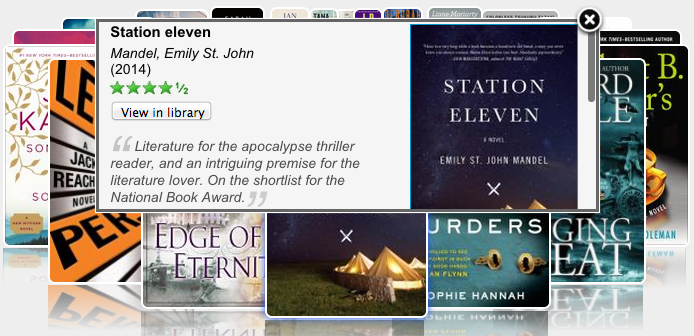
Introducing “Easy Share.” Easy Share is a tool for putting beautiful book displays on Facebook, Twitter, Pinterest, Tumblr, email newsletters and elsewhere. It works by turning our dynamic, moving widgets into shareable images, optimized for the service you’re going to use them on.

Why would I want an image of a widget?

Dynamic widgets require JavaScript. This works great on sites you control, like a library’s blog or home page. But many sites, including some of the most important ones, don’t allow JavaScript. Easy Share bridges that gap, allowing you to post your widgets wherever a photo or other image can go—everywhere from Facebook to your email newsletters.

How do I find Easy Share?

To use Easy Share, move your cursor over a Book Display Widget. A camera icon will appear in the lower right corner of the widget. Click on that to open up the Easy Share box.

How can I share my widgets?

You can share your widget in three ways:

  1. Download. Download an image of your widget. After selecting a size, click the “down” arrow to download the image. Each image is labeled with the name of your widget, so you can find it easily on your computer. Upload this image to Facebook or wherever else you want it to go.
  2. Link. Get a link (URL) to the image. Select the size you want, then click the link icon to get a link to copy into whatever social media site you want.
  3. Dynamic. “Dynamic” images change over time, so you can place a “static” image somewhere and have it change as your collection changes. To get a dynamic image, go to the edit page for a widget. Use the link there to embed this image into your website or blog. Dynamic widgets update whenever your widget updates. Depending on users’ browser “caching” settings, changes may or may not happen immediately. But it will change over time.

You can also download or grab a link to a image of your widget from the widget edit page. Under the preview section, click “Take Screenshot.” You can see our blog post about that feature here.

Check out the LibraryThing for Libraries Wiki for more instructions.

Interested?

Find out more about LibraryThing for Libraries and Book Display Widgets. And sign up for a free trial of either by contacting ltflsupport@librarything.com.

Labels: Book Display Widgets, new feature, new features, widgets

Thursday, September 25th, 2014

New Feature: Comments Revamp

Today we’re unveiling a major upgrade in how LibraryThing handles comments.

» You can skip all this talk and just see your comments page now.

The old system—in place since the dawn of LibraryThing (back when MySpace was on top and Facebook was just for Harvard Students)—was simple: everyone had a “comments” section on their profile. But it had drawbacks:

  • Real conversation was nigh-impossible. Messages “lived” in two separate places, with Person A writing on Person B’s profile, and person B replying on person A’s profile. Context was non-existent.
  • Everything was a comment—real comments, notes to people looking at your profile, system notifications, Early Reviewer notifications, etc.
  • Administration was a pain. There was no pagination, making some profiles unwieldy and slow. Members “archived” messages to get them off their profiles.

The new system is designed to fix all these problems, and add some features:

  • Comments now have a dedicated page, available from your profile and on every page.
  • You can now see “Conversations” with other members–a view of all the comments you’ve sent back and forth. The member names that show up immediately below “Conversations” on the left-hand menu are your most recent conversations.
  • The left of the comments page shows recent conversations. Clicking “See all…” shows a rather complete overview of all the conversations you’ve had on LibraryThing, sorted by recentness or “most” (which conversations have the most comments). You can also see conversations by the first letter of a member’s name.
  • Replies “live” where they’re posted. Replying to a comment left on your “Wall” will both notify the other member of your reply, and also keep the two (or three, etc.) messages together, in context.
  • Your comments are split into your “Wall,” system notifications and social notifications. We’re going to be doing more with notifications, now that we can separate them from your “real” messages.
  • Early Reviewers notifications are separated out too, if you’re an Early Reviewer.
  • To round out the categories, there are also links to “Archived” and “All.”
  • Everything is paginated, so the pages are small and you aren’t scrolling forever.
  • Comments now allow Touchstones to works and authors, so you can type “[The Once and Future King]” or “[[Mark Twain]]” and it will turn them into links to that work or author.

Your “Comment Wall” still lives at the bottom of your profile. You can also get to your comments page from anywhere on LibraryThing by clicking the number in the upper-right corner next to your member name. When you have a new comment, that number will have a yellow background. You can also reach your comments page by going to http://www.librarything.com/comments.

In addition to separating out actual comments from system and Early Reviewers notifications, which each have their own , we’ve also added some header icons to these messages, so, if you’re looking at “All,” you’ll know right away what kind of comment you’ve got.

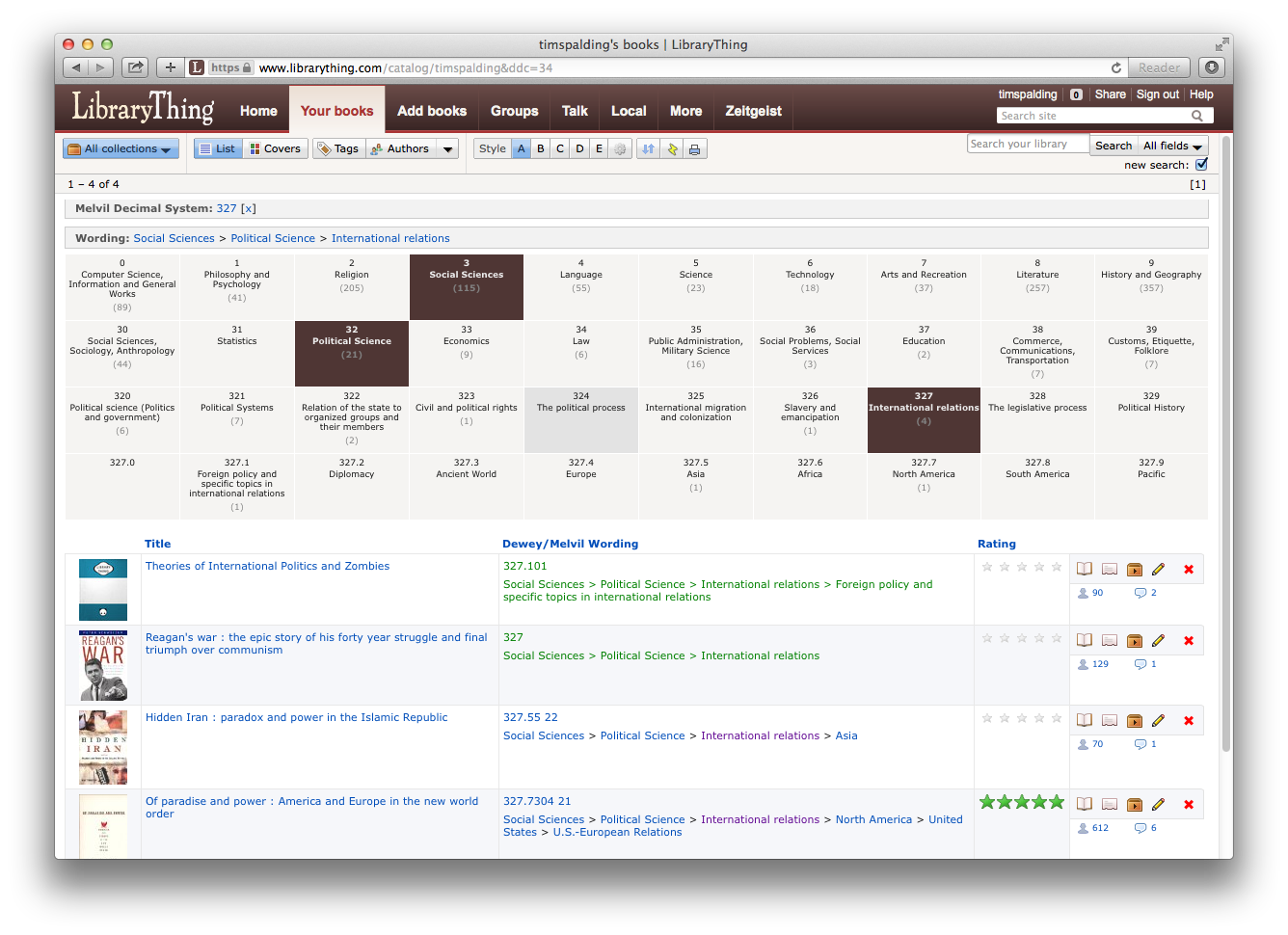
Below is a look at the “See all” page, which, in this case, gives you an idea of just how many conversations I have going. You can sort by most comments in a conversation, most recently updated conversation, or alphabetically by member name.

Click to enlarge

We’ve already got a lively discussion going on Talk: New Comments System.

Come tell us what you think!

Labels: new feature, new features

Tuesday, September 23rd, 2014

Welcome Kristi

We’re thrilled to welcome Kristi (LT member kristilabrie) to the team, as our new Project Specialist for LibraryThing.com. Say “hi” on her LT profile or on the “Welcome Kristi” Talk topic.

Last month, LibraryThing began scouring the Portland area for a new Junior Social Media Specialist. We interviewed a number of excellent candidates, and after meeting Kristi, decided to take the job in a different direction. While Loranne will continue to run Early Reviewers, social media, etc., Kristi will be keeping tabs on site business like managing new feature requests, keeping track of progress, and following up on bug reports. Expect to see a lot of her on Talk!

About Kristi

Kristi’s passions are eating, cooking, exploring the outdoors, eating, travel, and eating (did we mention she loves food?). While studying for her B.A. in Zoology, Kristi spent a semester in Tasmania where she fed kangaroos, explored the rainforest, and interacted with Tasmanian Devils. In 2010 she graduated and moved to Portland for a summer with Environment America, U.S. PIRG, and the Human Rights Campaign.

Kristi fell in love with what the city of Portland had to offer and decided to start planting her roots. She worked as an administrator at an independent children’s school for a few years and cultivated her love for lifelong learning, systems, and general technology geekery. She just recently purchased her first home with partner Chris in the summer of 2013. They live in a lake house with their two Maine Coon cats and hope to soon add a Golden Retriever puppy named Duncan to their family. In her spare time, Kristi is learning to kick box, paint, and practice permaculture on her property—where she can harvest food to eat. She loves DIY books and sci-fi novels!

Labels: employees

Wednesday, September 3rd, 2014

September Early Reviewers batch is live!

The September 2014 batch of Early Reviewer books is up! We’ve got 97 titles this month, with a grand total of 2,540 copies to give out.

If you haven’t already, sign up for Early Reviewers. If you’ve already signed up, please check your mailing/email address and make sure they’re correct.

» Then request away!

The deadline to request a copy is Monday, September 29th at 6pm Eastern.

Eligiblity: Publishers do things country-by-country. This month we have publishers who can send books to the US, Canada, the UK, Israel, Australia, France, Germany, and many more. Make sure to check the flags by each book to see if it can be sent to your country.

Thanks to all the publishers participating this month!

Taylor Trade Publishing Candlewick Press Chronicle Books
Prufrock Press Apex Publications Tundra Books
CarTech Books Ballantine Books Books to Go Now
Wild Flower Press Summertime Publications Inc Aspidistra Press
Firbolg Publishing Henry Holt and Company Akashic Books
Horrific Tales Publishing Random House Fitzhenry & Whiteside
Fog Ink Rara Avis Plume
Medallion Press Plough Publishing House Crown Publishing
ForeEdge University Press of New England Dartmouth College Press
Dragonwell Publishing Algonquin Books Human Kinetics
Galaxy Press Kurodahan Press BookViewCafe
Recorded Books Quirk Books Rockridge Press
JournalStone Palgrave Macmillan McFarland
Copper Bay Press First Life Publishing Secant Publishing
Prospect Park Books

Labels: early reviewers, LTER

Thursday, August 28th, 2014

September ReadaThing kicks off today!

It’s not too late to join in our extended weekend ReadaThing. All are welcome, and you don’t have to read for the full weekend: the goal is to have a few people from around the world reading at any given time during the ReadaThing.

This edition of ReadaThing will be kicking off at 12am (midnight) UTC on Friday, August 29th (that’s 8pm Eastern, Thursday August 28th), and will end at the same time on Tuesday—12am UTC, September 2nd (8pm Eastern, Monday, September 1st). You can see the full timeline here. This August/September ReadaThing also happens to coincide with the US’s Labor Day weekend, so, to our US readers, if you’re looking for an excuse to get some more reading in this weekend, here’s your chance!

Sign up

Head directly to the August-September 2014 ReadaThing Wiki to sign up, or check out the announcement thread for more general information. You don’t have to pick a time slot in advance in order to participate! There’s a special place for readers who don’t want to commit to a specific schedule to sign up.

What are you reading?

Whether you’d like to check out what your fellow ReadaThing-ers are reading, or to share your own ReadaThing picks, head over to the What will you be reading? thread to see what books are slated. Remember: anything goes! You can read whatever you want, wherever you want.

Get ready to read

Once the ReadaThing is underway, keep an eye out for the “August-September 2014 ReadaThing: Log Book” thread, where you can document your ReadaThing experiences. Take a peek at the Log Book thread from our last ReadaThing in April, for examples.

ETA: You can find the August-September ReadaThing Lobg Book here!

If you’ve never done ReadaThing before, you’re in good company—this is my first one. Give it a try, and stay tuned to the ReadaThing group for updates. Thanks to LT member LucindaLibri for organizing this ReadaThing!

Labels: readathon, reading, Uncategorized

Wednesday, August 20th, 2014

Q&A with Andy Weir

Some excerpts from our interview with author Andy Weir, which initially appeared in August’s State of the Thing.

Andy Weir has spent the bulk of his career up to this point as a software engineer. The success of his debut novel, The Martian has been the result of a remarkable journey, and is very much deserved. It’s little wonder that the author identifies as a “lifelong space nerd.”

Tim caught up with Andy this month to talk science, space, writing, and more science!

Tell us what your novel is all about.

It’s about an astronaut who gets stranded on Mars (the rest of his crew thought he was dead). Now he has to survive with the equipment he has on-hand.

The Martian has both a great narrative and an engrossing focus on scientific and practical specificities. What drove what?

Definitely the science drove the plot. The problems he faced were real issues someone in that situation would face, and his solutions had to solve them. So those problems, and their solutions, are what moved the plot along.

The science is real, right?

As best as I could make it, yes. I put a lot of effort into scientific accuracy. I did a ton of research and math to work everything out. I’m sure I made some mistakes, but for the most part, the science is solid.

I gather you even wrote an orbital mechanics program to figure out certain details in the novel. I have to ask, are you insane?

Haha, maybe. But I wanted everything to fit right. So I wanted to know how long it would take to get there with a constantly accelerating ship and what path they’d take.

As I said, before, it’s a page turner. Did you have any models for the narrative?

I didn’t really have any model, per se. The story is very linear. Each problem needs a solution, and usually the solution causes the next problem. All I had to do was have Mark narrate the situation with a smart-ass tone of voice.

The Martian had an unusual path to publication—free, then self-published and finally picked up by a major publisher. What does that tell us about your book, or about publishing in general?

It’s pretty cool. It means any schmoe can break into the writing world on their own. Self-publishing an electronic edition of your book costs you nothing, and if people like it, you’ll do well.

»For more from Andy, check out our full interview here.

Labels: author interview

Tuesday, August 12th, 2014

Job: Junior Social Media Specialist in Portland, ME

This could be you! (photo by bluesky1963)

LibraryThing is hiring a full-time Junior Social Media Specialist. We’re looking for someone who is bookish, local (Portland, ME area), and social media-savvy. You’d be working closely with Loranne, our Member Support and Social Media Librarian, here at LTHQ in Portland.

You must:

  • Live in or near Portland, ME
  • Love books
  • Love people, at least sometimes
  • Be familiar with social media, and bookish social media
  • Write and edit well and quickly
  • Work both independently and under direction
  • Be hard-working, organized, and detail-oriented enough to remember to title your job application email “[Name]: Job Application”
  • Be aware of What Makes LibraryThing LibraryThing

We’ll pick smarts, affability and drive over any skill. But our ideal candidate would have:

  • Book-world experience
  • Professional social media experience
  • Technical skills (HTML, CSS, SQL)
  • LibraryThing membership/familiarity

Your duties include:

  • Help members with problems via email, Talk and social media
  • Help write our monthly newsletters, blog posts, tweets, and Facebook posts
  • Help developers to develop and test new features and projects
  • Be an active presence on the site
  • Manage incoming/outgoing mail, and some general office management tasks

Compensation:

Experience-appropriate salary with gold-plated health and dental insurance. We require hard work, but we are flexible about hours, and–so long as you are in the area–where you work from.

How to apply:

Send your resume (in PDF format, please) to loranne@librarything.com. Your email should be your cover letter.

Fine Print:

Per our Privacy Policy, LibraryThing is an equal opportunity employer and will not discriminate against any employee or applicant on the basis of religion, race, color, national origin, ethnic origin, age, sex, disability, sexual orientation, gender identity, gender expression, pregnancy status, parental status, marital status, veteran status or any other classification protected by applicable federal, state, or local law.

Labels: employment, hiring, jobs