Archive for the ‘authors’ Category

Thursday, April 26th, 2012

April Author Interviews!

This month’s State of the Thing, LibraryThing’s monthly newsletter of features, author interviews and various forms of bookish delight, is on its way to your inbox. You can also read it online. It includes a reminder about our Edible Books Contest and more!

For one of our author interviews this month, I talked to Elizabeth Little about her new book Trip of the Tongue: Cross-Country Travels in Search of America’s Languages, published this month by Walker & Company.

What was the most enjoyable moment in researching Trip of the Tongue? The worst?

My most enjoyable moment was, without a doubt, my first evening in Neah Bay, a tiny town on the tip of the Olympic Peninsula in Washington State. I had just spent the past few days with friends in Tacoma, and I was loathe to leave their hospitality for what sounded like an uncomfortably rustic accommodation in the middle of nowhere. But then I discovered that I was staying in a cozy little cabin a stone’s throw away from this windswept gem of beach. That evening I walked along the sand in my bare feet as the sun set. Then I returned to my cabin to drink hot chocolate and read about language. A near-perfect evening.

My least enjoyable moment, on the other hand, was surely when I was in northern Maine, when I got caught in a snowstorm and had to battle all-day morning sickness. There’s a very good reason why that section didn’t make it into the book.

How did you end up deciding which particular languages to highlight in the book? Were there some that just barely didn’t make the cut that you’d like to tell us about?

The languages that made it into the book were those that really challenged my own assumptions about the history of language—or language itself—in the United States. I spent some time in San Francisco, for instance, but my background in Chinese language and culture made for a less than compelling narrative thread. It was a lot of “Oh, yes, I remember reading about that.” (Looking back on things now, I wish I had tried to look at Chinese language and culture in Old West frontier towns. Although that should probably be a book of its own.)

Some other sections had to be set aside because they led me down a very different path than the one I was trying to travel. The chapter that got cut at the very last minute was a chapter that looked at the impact of technological change—very particularly in transportation and manufacturing—on language communities in Baltimore, Cleveland, and Detroit. I loved my time in each of those cities – in Baltimore I met the loveliest and most helpful docent and historian at the city’s Jewish museum; in Cleveland I gorged on paprikash and learned about Hungarian girl scouts; and in Detroit I went to the Ford Rouge Factory, which turned out to be one of my favorite activities on the entire trip. Unfortunately, when I found myself compiling economic paper after economic paper for research purposes, I had to acknowledge that my focus was starting to drift.

In the final chapter of your book, you note that Trip of the Tongue didn’t end up being the book you thought it would be. How did you originally envision it, and how did your travels and experiences change the book into what it is?

At the beginning I envisioned that the book would be more of a romp: road-tripping high jinks with some linguistic data thrown in. What I ended up with, though, is something more like a meditation. On language, on discrimination, on my own preconceived notions. I first got an inkling of this in South Carolina, where I went to learn about Gullah. My very first day in Charleston, I learned about these spikes (called chevaux-de-frise) that some city residents put on their fences in the nineteenth century to protect themselves in the event of a slave rebellion. It was at that point that the desire to write anything resembling a romp died a swift death. The history of race and language and culture in the United States isn’t exactly rich in comedy. (Though I certainly tried to find it where I could.)

But I’m glad that I ended up somewhere very different than I’d intended. Because it’s not much of a journey of discovery if you only learn things you already knew.

Read the rest of our interview with Elizabeth Little.

I also talked to Diana Preston, the author of The Dark Defile: Britain’s Catastrophic Invasion of Afghanistan, 1839-1842, published earlier this year by Walker & Company.

For those who haven’t yet had a chance to read the book, give us a thumbnail synopsis of the First Anglo-Afghan War: how did the conflict come about, how long did it last, and what was the result?

The First Anglo-Afghan War in 1838-42 is one of Britain’s most notorious military catastrophes. The genesis of the war was British suspicion that imperialist and expansionist Russia was planning to advance through Afghanistan to invade India, Britain’s richest and most prized colonial possession. The Afghans resented the British presence, and the invasion was politically controversial at home. Barely two years after the British had occupied Kabul thousands of British and Indian troops, officials and their dependents suddenly found themselves besieged. A disastrous retreat to India under constant attack by the Afghan hill tribes left only one Briton and several Indian soldiers alive. When the news of the disaster reached Britain, it was greeted with anger and the British sent an army of retribution to punish the Afghans. Soon afterwards, the British withdrew from Afghanistan with their puppet king already murdered, allowing Dost Mohammed, who had surrendered to the British and been exiled by them, to return. The entire enterprise was a disaster that soured British-Afghan relations for many years.

How did you come to be interested in the conflict, and how long was the research process for The Dark Defile?

I’ve been interested in the conflict for a long time and in particular in some of the characters but the more I began delving into the sources the more I realized it is something of a cautionary tale. The Duke of Wellington (the conqueror of Napoleon at Waterloo and a former Prime Minister) predicted at the time—accurately as it turned out—that “The consequence of crossing the Indus once, to settle a government in Afghanistan, will be a perennial march into that country.” (British forces entered Afghanistan twice more over the subsequent 80 years, before doing so again as part of the current NATO-led force.) I became increasingly intrigued not only by what actually happened and the many vivid personal stories but also by the wider political and strategic issues surrounding the campaign.

Subsequent research in the UK and northern India took about two years.

I was struck by Lady Florentia Sale, whose diary of the war you draw on frequently in the book. Tell us how Lady Sale ended up in the middle of the conflict, and about her diary which recounts so vividly the events she witnessed.

Plain-speaking, fifty-year-old Florentia Sale arrived in Kabul to join her husband, a senior British officer nicknamed “Fighting Bob”. She devoted her early months to planting a flower garden but when the Afghans rose up she found herself trapped in Kabul without her husband who had left with his regiment for India. She commented acidly on subsequent British military incompetence and diplomatic vacillation, writing, “it appears a very strange circumstance that troops were not immediately sent into the city to quell the [rising] … but we seem to sit quietly with our hands folded and look on … General Elphinstone vacillates on every point. His own judgment appears to be good but he is swayed by the last speaker …”

She survived the early days of the British retreat, caring with her pregnant daughter for her dying son-in-law, a wounded British officer. She was then taken hostage by the Afghans. Her clear-eyed, unsentimental, occasionally humorous diary provides a detailed account of events, both previously in Kabul and then in her captivity and—unlike some of the other eyewitness accounts written with an eye to publication—rings true to the core. She describes how, as she and the other prisoners were bundled away by their Afghan captors, they passed naked starving people left behind by the retreating British column who were surviving “by feeding on their dead comrades.” She also wrote that she and the other prisoners quickly became verminous—”very few of us … are not covered with crawlers”—and learned to distinguish between lice which they called “infantry” and fleas which were “light cavalry”. She lived to be eventually reunited with her husband.

Read the rest of our interview with Diana Preston.


Catch up on previous State of the Thing newsletters.

If you don’t get State of the Thing, you can add it in your email preferences. You also have to have an email address listed.

Labels: author interview, authors, state of the thing

Friday, February 24th, 2012

February Author Interviews: Matthew Pearl and Leah Price

This month’s State of the Thing, LibraryThing’s monthly newsletter of features, author interviews and various forms of bookish delight, is on its way to your inbox. You can also read it online.

For our author interviews this month, I talked to Matthew Pearl about his new book The Technologists, published this week by Random House. The novel focuses on the early years of the Massachusetts Institute of Technology, as students in its first graduating class face down a mysterious force bent on destroying their school and their city.

Which part of The Technologists came to you first?

The first scene I envisioned was one that appears early in the novel, when a group of the original MIT students are bullied by a Harvard crew team as both groups row the Charles River. It’s still an important scene for me when I think about the book and especially the main character. The early MIT students were ultimate underdogs and this moment captures that, plus introduces the Boston backdrop.

Your previous books have put major literary characters at the center of the action; what made you decide to use college students this time around?

For many if not most people, college is a formative and unique experience in their lives. Different from any time before or after. “The best four years of your life”? Maybe, though probably not. But certainly among the most interesting. I really loved releasing my characters into that context.

Did you find it easier to write using fictional protagonists rather than historical characters?

The Technologists has a mix of fictional and historical characters. The central protagonist, Marcus Mansfield, is fictional, though based on my research into many of the original MIT students. It’s hard to say what ends up making writing “easier,” at least for me, because the long process of writing the novel inevitably complicates every task. Still, I can’t deny there’s a liberating quality when working with fictional characters after spending time on historical figures with more established profiles!

Read the rest of our interview with Matthew Pearl.

I also talked to Leah Price, the editor of Unpacking My Library: Writers and Their Books, published late last year by Yale University Press. The book includes interviews with thirteen contemporary writers about their libraries, plus some wonderful pictures of their books.

Were there any responses to the interview questions that surprised you?

I was surprised—even touched—by how intimate some of the answers were.  Questions about a writer’s relation to his books somehow yielded answers about a writer’s relation to his father, his lovers, even his exes. Junot Diaz told me that “When I was still with my ex, I drove back and forth between New York and Cambridge seven to eight times a month, and that’s how I got into audiobooks. I liked reading to my ex. Never read to anyone else. Never had anyone read to me, really.” Just as poignantly, Lev Grossman pointed to a bookshelf custom-built for the apartment he used to share with his ex-wife. “Funny how libraries retain ghostly impressions of the past,” he reflected: “those bookshelves retain the dimensions of those old rooms, not of the rooms they’re currently in, so they’re slightly ill-fitting.” Both writers think of books as something shared with other people, or tainted by memories of the people with whom they were once shared – which helps makes sense, in a way, of the success of LibraryThing in building social relationships via books and circulating books by forging virtual networks.

I also asked Leah to tell us about her personal library and how she organizes her own books (and she sent along a picture of her shelves, too):

I alphabetize my books by author, because I’m the kind of obsessive-compulsive who also alphabetizes the spices and color-codes the socks. My books are divided between home and office, but paradoxically the ones that are most on display, in my office on campus, are the least revealing, because when I’m at work I rarely have time to read anything longer than an e-mail or a memo, and so that’s where I keep the books that I don’t have any intention of rereading.

At home, we segregate the cookbooks (though, inconsistently, I have a beautiful 1880s edition of Mrs Beeton’s Household Manual filed under B, because I don’t have any intention of cooking suet pudding), and there are a few straggler sections dating back to the days before my library started to flirt with my partner’s. When we moved in together he started pulling books out of boxes and plopping them down on the shelves without regard to which were mine and which were his. I panicked, because I had assumed that we wouldn’t interfile our books, just as blithely as he had assumed that we would. A family therapist would probably add interfiling to the list of things to negotiate in advance: blended families are nothing to merged libraries. Now that our books are promiscuously mingled, we’re getting married next month, but that feels like a formality compared to the day when we steeled ourselves to put duplicates out on the curb. Once you’ve ditched somebody’s copy of Middlemarch, you might as well have signed up for a covenant marriage.

Read the rest of our interview with Leah Price.


Catch up on previous State of the Thing newsletters.

If you don’t get State of the Thing, you can add it in your email preferences. You also have to have an email address listed.

Labels: author interview, authors, state of the thing

Thursday, January 26th, 2012

January Author Interviews

This month’s State of the Thing, LibraryThing’s monthly newsletter of features, author interviews and various forms of bookish delight, should have made its way to your inbox by now. You can also read it online.

We had a whole host of author interviews this month:

I talked to Shalom Auslander about his first novel, Hope: A Tragedy, out this month from Riverhead Books.

Which of these characters came to you first? Which was the most fun to create?

Kugel, the main character, came first; I liked the idea of a character whose tragic flaw was hope, the very thing we’re supposed to never give up or go without. And yet here was a person, it seemed, whose hope was getting him hurt, who might be better off if he gave up and just accepted things as they are, i.e. crappy. Mother, though, was the most fun to create. She is eternally hopeless and finds glory in suffering and pain in joy; I was given birth to by people just like that. Also, she moans about being in the Holocaust, which she never was, and that makes me laugh.

Read the rest of our interview with Shalom Auslander.

I also talked to Theodora Goss about her latest book, The Thorn and the Blossom: A Two-Sided Love Story, published this month by Quirk Books. You may want to watch the book trailer to get a sense of the book’s interesting design.

How did you come up with the idea to have the book designed this way, as a “two-sided love story”? Can you describe the design process bit for us?

I actually didn’t come up with the idea of the two-sided design myself. My wonderful editor, Stephen Segal, came up with it and called me to ask if I could write a story that would fit the format. It was quite a challenge! We didn’t want a story that would simply have two sides to it—that wouldn’t really be using the format. We wanted a story that could only be told in this way, that would use the format as part of the reading experience. And I think when you read the book, you’ll find that it does. You can only understand the story, particularly the conclusion, by reading both sides.

But I was the one who decided that it should be a love story (after all, what other kind of story is so particularly two-sided?), and who came up with the story of Brendan and Evelyn. And after I had come up with it, the basic plot and the characters, then the characters started talking to me, as they do anytime you write a story. They started telling me what they wanted to say and do.

I should also mention the wonderful artist, Scott McKowen, who captured the feel of the story so perfectly. I can’t think of a better way to present this book than the way Scott has presented it, with the gorgeous slipcase and the illustrations inside. I think in the end, the book was a collaborative effort between the three of us. And once it’s read, the readers will become a part of the collaboration as well, because this story isn’t just on the pages. In a sense, it exists between the two sides, and that’s the story the readers will have to put together themselves.

Read the rest of our interview with Theodora Goss.

My third interview this month was with Susan Goodman, the H. Brown Fletcher Chair of Humanities at the University of Delaware, and the author of Republic of Words: The Atlantic Monthly and Its Writers, 1857-1925, recently published by the University Press of New England.

The Atlantic Monthly’s founders laid out quite an ambitious goal for themselves in 1857, “to be the exponent of what its conductors believe to be the American idea.” How did they manage to make a success of their magazine when so many similar ventures did not last?

As the country’s most intellectual and literary city, Boston brought together men and women who from the beginning of the magazine made it a powerful voice in American politics as well as the arts. Its success depended on a loyal group of contributors, informed and curious readers, often intent on self-improvement, and good management. Luck also played a part. The first issue, for example, contained Ralph Waldo Emerson’s poem “Brahma”, which provoked a craze of parodies and made readers eager for the next issue.

Read the rest of our interview with Susan Goodman.

I also chatted with Jay Wexler about his new book The Odd Clauses: Understanding the Constitution Through Ten of Its Most Curious Provisions, published by Beacon Press.

You write in the introduction that you first got the idea for writing a book about the Constitution’s “odd clauses” while you were working in the Office of Legal Counsel for the Clinton administration. Do you recall a particularly odd question the OLC was called upon to advise on while you were there?

There were all sorts of odd questions, but the one I spent most of my time on had to do with whether the President had the authority to create a national monument in the middle of the ocean. President Clinton was interested in creating a giant national monument in Hawaii to protect coral reefs, but it’s not immediately clear that the relevant statute giving the President the authority to create monuments (it’s called the Antiquities Act) gives him the authority to make monuments in the ocean. The question required a good bit of statutory analysis as well as analysis of the proper scope of the so-called “Property Clause” of Article IV of the Constitution. The legal opinion that came out of all that work is here. As it turned out, it was President Bush, not Clinton, who ultimately made the Hawaii monument.

Read the rest of our interview with Jay Wexler.

And, last but not least, we have an interview with Susan Cain. Her first book is Quiet: The Power of Introverts in a World That Can’t Stop Talking, published this month by Crown.

You describe in your opening chapters the rise of what you call the Extrovert Ideal. Give us the nutshell version: what is this, and how did it come to be such a powerful force in American culture?

The Extrovert Ideal says that the ideal self is gregarious, alpha, and comfortable in the spotlight. Our schools, workplaces, and religious institutions are designed for extroverts, and many introverts believe that there is something wrong with them and that they should try to “pass” as extroverts. The bias against introversion leads to a colossal waste of talent, energy, and happiness.

In my book, I trace how we shifted from a “Culture of Character” into a “Culture of Personality” at the turn of the 20th century. Big business, the media, the self-help industry, and advertising all went through radical changes that had the effect of glamorizing bold and entertaining personality styles. I also tell the surprising life story of Dale Carnegie, who morphed from shy, awkward farm boy into bestselling author of How to Win Friends and Influence People, and is a fascinating example of this cultural transformation.

And I talk about why the Culture of Personality is not a great model for the 21st century.

Read the rest of our interview with Susan Cain.

Catch up on previous State of the Thing newsletters.

If you don’t get State of the Thing, you can add it in your email preferences. You also have to have an email address listed.

Labels: author interview, authors, state of the thing

Friday, December 2nd, 2011

Author Interview: Anthony Horowitz

We’ve got a special mid-month author interview with Anthony Horowitz, the author of the popular Alex Rider series of books as well as several popular UK television series and mini-series, including “Foyle’s War,” “Midsomer Murders,” and “Poirot.” Anthony’s latest work is The House of Silk, a new Sherlock Holmes adventure published last month by Mulholland Books.

You’ve written that you “paused for at least half a second” before agreeing to write a new Sherlock Holmes novel. What made you hesitate, and how did you
overcome the hesitation?

I had two concerns. The first was that, with so much Sherlock Holmes around—the Robert Downey Jr. films and the very successful TV series on BBC—I might be seen as jumping on a bandwagon. Also, I have my doubts about this rash of prequels, sequels and add-ons that are appearing. Are they just a cynical way to sell books? I agreed only because I love Sherlock Holmes and couldn’t resist the idea of moving into 221b Baker Street for a short while. I knew I could write a good book. I knew I would enjoy writing it. In short, I couldn’t resist it.

What sort of research or preparation did you do before you started writing?

I began by re-reading the entire canon, which didn’t take long. There are only 56 short stories and four novellas. I have to say that it was great to have an excuse to immerse myself once again in Sherlock Holmes. I then read a couple of books about nineteenth century London which helped me decide on some of the locations. The plot for The House of Silk came very quickly. I actually started writing it a week after I signed the contract … the prologue and chapter one, anyway. That was how I found my voice.

Did you find any aspect of writing The House of Silk particularly challenging (or particularly easy)?

The biggest challenge was to stretch the very elegant but fragile structures of the original Doyle novels to the 95,000 words demanded by my editors. I overcame this by effectively writing two short novels‐The Man in the Flat Cap and The House of Silk‐and intertwining them. I never use the word “easy” about writing but I have to say that I loved writing the book and that an awful lot of it seemed to fall into my lap. It took four months‐half the time of an Alex Rider novel.

What do you think it is about Holmes and Watson that makes them such wonderfully lasting characters?

It’s their interdependence. Doyle’s genius was to create a character who is cold, aloof, irritating, an occasional drug addict, a man who never reads fiction and knows nothing about philosophy or politics … and to partner him with a warm, affable, civilized, intelligent and totally loyal doctor. We read the books for the atmosphere and for the mysteries but above all because this is the greatest friendship in literature.

Do you have a favorite Sherlock Holmes story? If so, which, and why?

My favourite story is “The Dying Detective” (which takes place three days before The House of Silk begins). It’s a chamber piece. There’s no detection and no actual crime. But it’s a great duel of wits with a memorable villain and a startling denouement.

Read the full interview.

Labels: author interview, authors

Tuesday, November 1st, 2011

Big “other authors” changes

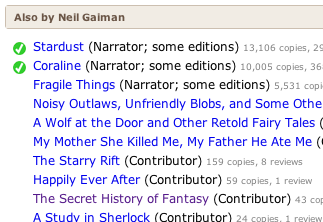
We’ve just pushed some rather major changes to how LibraryThing displays authors, as well as other contributors to a work, like translators, editors, etc. This functionality has been around for a few months for members of the Board for Extreme Thing Advances, but we’ve improved it and released it. We thank them very much for helping us get it right!

LibraryThing has long allowed you to edit and add multiple authors and their “roles” within their catalogs, the so-called “book level.” Now, work pages also include an “Other authors” module with a link to “Add/edit other authors.” Clicking that link will open up a lightbox where you can add, edit, confirm or reject other author entries for that work, assign the various authors to the correct roles, and mark whether they apply to the entire work or to only some editions. By popular request we have also opened up the “primary author” to editing, so you can now edit them, and their roles.

Some examples:

Other authors who apply to all editions of the work will show up at the top of the work page, like A Passion for Books, where Ray Bradbury wrote the foreword. Authors who contributed to some editions will show up in the “Other authors” section, linked from the top of the page: an example is Keigo Higashino’s The Devotion of Suspect X, showing Alexander O. Smith as the translator.

We’ve also added the ability to edit the name and add a role for the “primary” (ie., “lead”) author of a work, something much-requested during the BETA test of this feature. There’s no real need to do this for single-author books, but for some types of works it’ll be useful. Examples:

There will, of course, be debate on the issue of main and secondary authors. Generally speaking, co-author or co-editor status falls under the “main author” setting, while most other roles would count as “secondary author.” Obviously there will be exceptions to this, such as a book of photography or artwork where the artist rises to the level of “main author”.

This concept of “other authors” is live across the site, but it will take a while to play out how it should appear everywhere. But we wanted to get it out there and let you all have a go.

Come talk about the feature here, or report bugs here.

The changes prompted but do not require a change to how book/work pages show their book- and work-level data. This question is being discussed here.

Labels: authors, new feature, new features